Planning a team event in Portland means finding something people actually want to do—and something that still works when the forecast turns gray. The best activities give coworkers a reason to interact without making every conversation feel like an icebreaker.
Whether you’re organizing an employee appreciation afternoon, a company retreat, or a holiday party, these 10 indoor team-building ideas offer a mix of casual play, friendly competition, and shared experiences.
1. Mobile Mini Golf
Best for: Employee appreciation events, office parties, and celebrations where people want to play and socialize at their own pace.
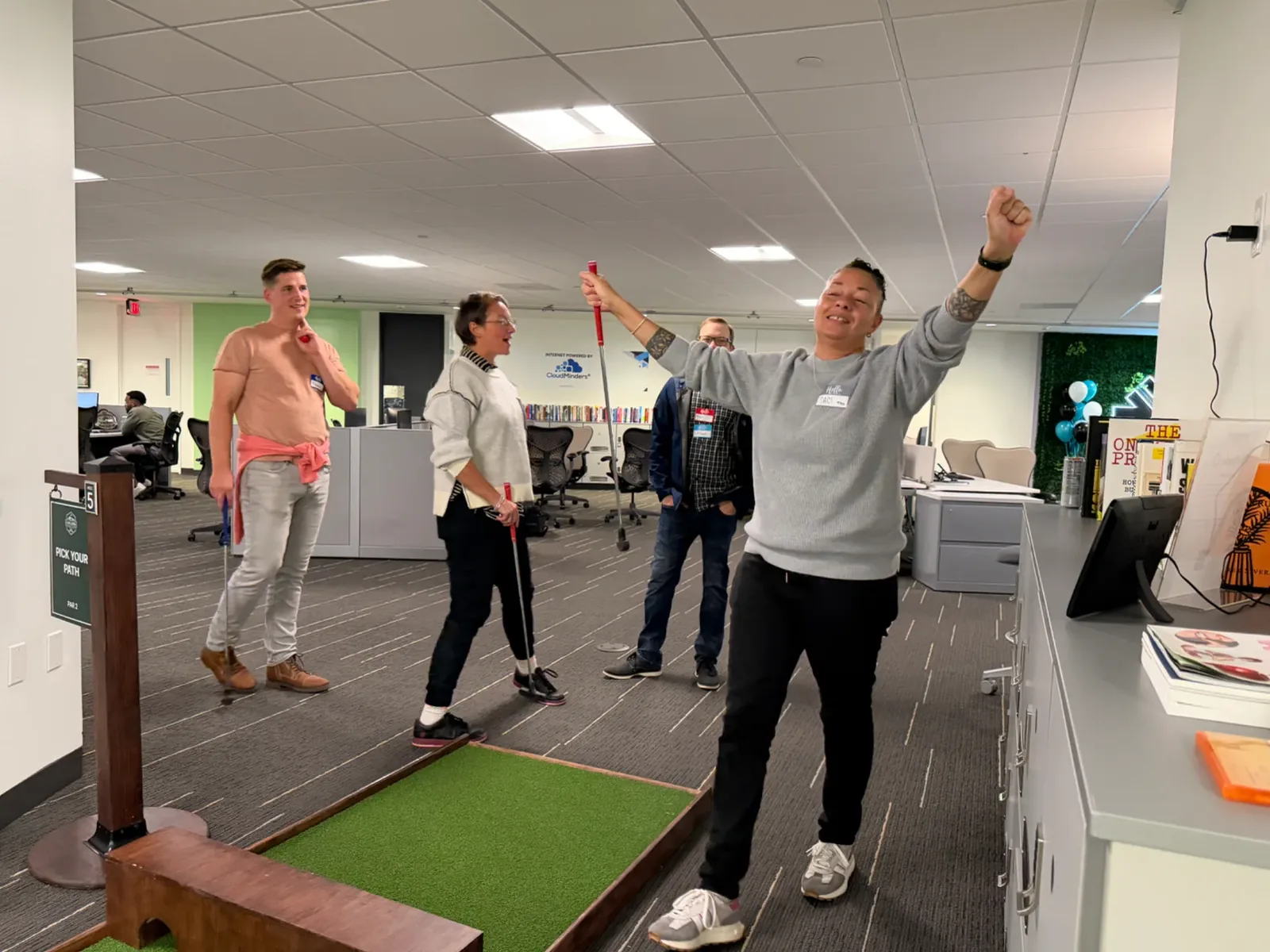
Mini golf gives coworkers something to do together without requiring golf experience. A missed putt can start a conversation just as easily as a hole-in-one, and guests can join a round between snacks, drinks, and catching up.
At Cascadia Putting Club, we bring six-, nine-, and 18-hole courses into offices and event venues around Portland. For a seasonal company celebration, explore our Portland holiday-party mini golf packages.
How much space and time should you plan for?
- Six holes: Approximately 500 square feet minimum, with two hours of active play included.
- Nine holes: Approximately 700 square feet minimum, with three hours of active play included.
- 18 holes: Approximately 1,500 square feet minimum, with four hours of active play included.
These are starting points for flat, level space—not a substitute for reviewing your floor plan. Leave room for people to move comfortably, and keep entrances, exits, and food-service areas clear. Our mini golf planning FAQ covers surfaces, access, and rental timing.
A group of four typically completes nine holes in about 30 minutes. Multiple groups can play at once, with guests joining throughout the event. Our nine-hole package is positioned for 50–100 event guests; that is a total-event planning guide, not the number playing simultaneously. Your schedule and participation format affect how many people can get a round in.
A real Portland office example
For UpStart Collective’s fourth-anniversary party, we spread six holes throughout its fifth-floor office at U.S. Bancorp Tower, better known as Big Pink. Guests explored the space, played, and met people from Portland’s startup and business community.
For your own event, choose casual open play or a scored competition with a clear deadline for turning in results. If you want an event-branded keepsake, custom mini golf scorecards can carry your company logo, event name, and colors. Standard Cascadia Putting Club scorecards are already included.
2. Escape Rooms

Best for: Small teams that enjoy solving a shared problem.
An escape room gives everyone a common objective: find clues, connect the dots, and complete the challenge before time runs out. It works especially well when coworkers enjoy puzzles and want a more focused activity than a party.
Planning tip: Confirm the specific room’s player limit and full visit length, including the briefing. If your headcount exceeds one room’s capacity, ask about simultaneous bookings or staggered groups. Choose the theme and difficulty with the whole team in mind, and check accessibility and exit arrangements before booking.
3. Cooking Classes

Best for: Smaller groups that enjoy making something together.
Preparing a meal creates natural opportunities to divide tasks, learn from one another, and sit down together afterward. A hands-on class can give a retreat or team outing a satisfying beginning, middle, and end.
Planning tip: Confirm whether everyone cooks or watches a demonstration, how many people share each workstation, and whether the quoted session includes eating the meal. Collect dietary needs before choosing a menu. If you are bringing an instructor to your office, confirm the kitchen, power, water, and equipment requirements first.
4. Bowling

Best for: Casual outings with a familiar activity and time to talk.
Bowling gives a team an easy rhythm: take a turn, cheer someone on, and catch up between frames. You can keep scores informal or create mixed-department teams for a little friendly rivalry.
Planning tip: Book by lane capacity and reservation length, not just overall venue capacity. Ask how many players the venue recommends per lane and whether shoe fitting and food service use part of your booked time. Keep teams small enough that employees spend more time participating than waiting.
5. Trivia Competitions

Best for: Seated group events, department mixers, and office gatherings.
Trivia turns an ordinary meeting room into a shared challenge. Mix Portland questions with music, movies, food, and general knowledge so people with different interests have a chance to contribute. Keep company-specific questions light enough that new employees can join in.
Suggested format: Teams of four to six, with four short rounds and a break halfway through. Reserve 45–60 minutes for this version. You’ll need seating, a host everyone can hear, and a clear way to submit answers. This is a sample agenda you can adapt, rather than a provider’s standard package.
6. Creative Workshops

Best for: Teams that prefer conversation and making something over competition.
Painting, pottery, and craft workshops give employees a shared activity without a scoreboard. Choose a beginner-friendly project so the experience feels welcoming to people who haven’t picked up a paintbrush in years.
Planning tip: Confirm workspace per person, material requirements, and cleanup time. Ask whether everyone takes their project home that day; some projects need drying, firing, or later pickup. For an office session, check table protection and ventilation with the instructor.
7. Indoor Yard Games and Office Olympics

Best for: Open-house events and company parties with room for several activity stations.
Yard games can move indoors when the room and game suit each other. A mix of tossing, stacking, and strategy games gives people several ways to participate. Cascadia Putting Club’s yard and lawn game add-ons include cornhole, Giant Jenga, and 4-in-a-Row.
Suggested format: For an Office Olympics version, create three stations and rotate teams every 15 minutes. Add a short introduction and awards for an approximately one-hour activity. Confirm each game’s footprint and clearance before choosing it; throwing games need space away from walkways, glass, and food. A smaller room may be better suited to a few carefully chosen games than a full circuit.
8. Improv and Comedy Workshops

Best for: Teams interested in listening, creativity, and responding to one another.
A facilitated improv workshop can give employees a chance to try something new together. The right exercises focus on collaboration and building on another person’s idea, rather than expecting everyone to be funny on demand.
Planning tip: Ask the facilitator for a sample agenda and an approach that accommodates quieter participants. Confirm room layout, session length, and whether employees can observe or pass on an exercise. This option works best when the format matches your team’s comfort level.
9. Board Game Tournaments

Best for: Smaller teams, relaxed afternoons, and recurring office socials.
A few tables of approachable games can be enough to create a good team event. Offer a mix of cooperative games, quick card games, and light strategy so employees can find a table that suits them.
Suggested format: Choose games that fit a 20–30-minute round, then allow 60–90 minutes for introductions and two or three rounds. Check the player count on each game and have someone ready to explain the rules. Keep a casual table available for people who would rather play than compete in a tournament.
10. Indoor Scavenger Hunts

Best for: Retreats and offices with enough shared space for teams to explore.
A scavenger hunt turns familiar surroundings into a shared puzzle. Teams might solve clues, find objects, or complete creative challenges connected to your company or event theme.
Suggested format: Teams of three to five, with 30–45 minutes for the hunt and a short wrap-up afterward. Test the clues before the event, define the permitted areas, and keep challenges out of working offices. Offer routes and tasks that work for participants’ mobility needs, and make photography optional.
How to Choose the Right Activity for Your Team
Start with the experience you want people to have. A celebration may call for relaxed games and conversation; a retreat may benefit from a scheduled activity with a shared goal.
- Match the format to attendance. If people arrive at different times, choose open play. A hosted workshop or trivia competition needs a shared start time.
- Check usable space. Measure the area available after tables, chairs, catering, and walkways are accounted for.
- Separate activity time from event time. A three-hour party does not mean every employee wants three hours of structured participation.
- Make joining easy. Explain the rules briefly, welcome beginners, and give people a comfortable way to watch or take a break.
- Confirm the details. Provider-led activities have their own capacities and durations. The suggested DIY schedules above are starting points for your planning.

Bring Indoor Mini Golf to Your Next Portland Company Event
If you want an activity that fits around conversation, food, and a little friendly competition, mobile mini golf is an easy place to start. Cascadia Putting Club serves Portland, Beaverton, Hillsboro, Vancouver, and the surrounding metro area.
Send us your date, venue, estimated headcount, and available space. We’ll help you choose a course and playing format that fit your event.
Request a quote for your Portland team event.