We've all been to networking events that follow the same formula. A room full of people, a few appetizers, a bar, and the expectation that everyone will introduce themselves to strangers.
For some people, that's easy. For others, it's the most uncomfortable part of attending a conference or professional event.
The challenge for event planners is creating opportunities for people to connect without making the experience feel forced.
One way to do that is to give guests something to do together. Whether it's a game, a shared challenge, or a conversation prompt, a little structure can make it easier to get past the usual introductions.
Here are 7 interactive networking event ideas worth considering for your next conference reception, corporate mixer, or professional gathering.
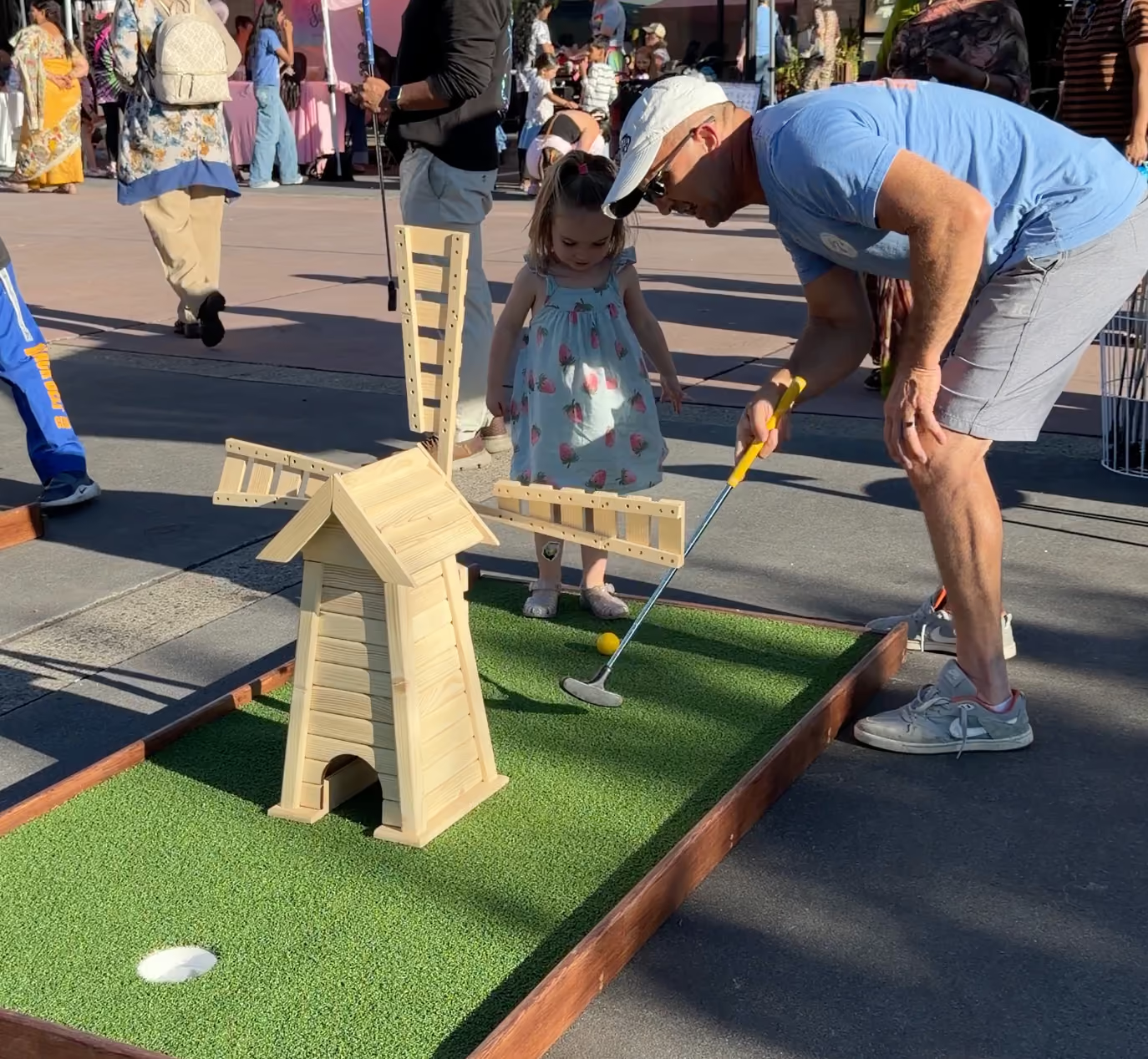
1. Set Up a Mini Golf Course
Best for: Conference receptions, corporate mixers, association events, and larger networking gatherings.
Mini golf gives guests a reason to interact beyond exchanging names and job titles.
Instead of approaching a stranger and trying to start a conversation, attendees can join a group for a few holes, compare scores, or challenge someone to a friendly competition.
The nice thing about mini golf is that it doesn't require a formal schedule. People can play when they're ready, and conversations can happen naturally along the way.
At Cascadia Putting Club, we bring portable mini golf courses to event venues, offices, and conference spaces throughout Portland and the surrounding area.
Our six-hole course typically requires around 600 square feet, while nine holes need approximately 900 square feet. We can also incorporate custom scorecards, branded signage, or a leaderboard to fit the event.
A real Portland example: For UpStart Collective's fourth-anniversary celebration, we set up six holes throughout its fifth-floor office in downtown Portland. Guests played while exploring the space, catching up with familiar faces, and meeting new people.
For networking events where guests are free to move around, a drop-in activity like mini golf can complement the food, drinks, and conversation already happening.
2. Organize Speed Networking
Best for: Professional associations, industry conferences, and business networking groups.
Speed networking takes the familiar concept of speed dating and applies it to professional introductions.
Participants are paired for a short conversation, usually three to five minutes, before moving on to the next person.
It's a straightforward way to help attendees meet more people than they might during an unstructured reception.
To make it more engaging, provide a few conversation starters beyond the standard "What do you do?"
For example:
- What's something exciting you're working on?
- What's one challenge you're hoping to solve this year?
- What's the most interesting thing you've learned recently?
Planning tip: Use speed networking near the beginning of an event, then leave time afterward for guests to continue conversations with people they'd like to know better.
3. Create a Collaborative Trivia Competition
Best for: Corporate gatherings, industry associations, and smaller conference receptions.
Trivia gets people working together toward a common goal.
Instead of letting attendees form teams exclusively with coworkers, encourage them to join people from other companies or departments.
Questions can focus on pop culture, local Portland history, industry knowledge, or fun facts about the event's host organization.
Consider running a few short rounds rather than a full-length trivia night. That way, guests still have plenty of opportunities to mingle.
Planning tip: Keep questions accessible. The objective is to create conversation and collaboration, not test specialized knowledge.
4. Add Conversation Prompts to Name Badges
Best for: Conferences, professional associations, and networking events with limited budgets.
Sometimes the simplest ideas are the most practical.
Instead of giving guests a name badge that only lists their name and company, add a prompt that helps someone start a conversation.
Examples include:
- Ask me about...
- I'm looking to connect with...
- My favorite Portland restaurant is...
- A project I'm excited about is...
You can even let guests write their own answers during registration.
It's inexpensive, requires very little space, and gives attendees a natural opening when approaching someone new.
Planning tip: Make the prompt large enough to read comfortably without having to stand uncomfortably close to someone.
5. Host Topic-Based Networking Tables
Best for: Industry conferences, educational events, and professional development gatherings.
Not everyone enjoys walking into a room and introducing themselves without knowing what to talk about.
Topic-based networking tables solve that problem by organizing conversations around shared interests.
For example, a marketing conference might have tables dedicated to artificial intelligence, brand strategy, social media, and customer acquisition.
Attendees choose the topics that interest them and join conversations already in progress.
You can assign a moderator to each table to keep discussions moving and help newcomers participate.
Planning tip: Allow guests to switch tables during the event so they can meet people with different perspectives.
6. Create a Networking Scavenger Hunt
Best for: Large conferences, trade shows, and multi-room events.
A networking scavenger hunt encourages guests to explore the venue and interact with people they might not otherwise meet.
Give attendees a list of challenges such as:
- Meet someone attending the conference for the first time.
- Find someone who works in a different industry.
- Visit three sponsor booths.
- Meet someone who traveled from another state.
- Find someone who shares one of your hobbies.
Participants can complete challenges individually or in small teams.
For a little added excitement, offer a prize drawing for everyone who completes a certain number of tasks.
Planning tip: Make participation optional and avoid challenges that pressure attendees to share personal information.
7. Introduce Hosted Small-Group Conversations
Best for: Executive gatherings, professional associations, and networking events focused on meaningful business connections.
Not every networking event needs games or entertainment.
For some audiences, a thoughtfully facilitated small-group conversation can be the most valuable activity of the evening.
Divide attendees into groups of four to six and give each group a question or topic to explore.
For example:
- What's one challenge your organization is facing?
- What industry trend do you think deserves more attention?
- What's a lesson you've learned that others might find useful?
After 15 or 20 minutes, invite participants to rotate into new groups.
This approach creates a little structure while still allowing for genuine discussion.
Planning tip: Have a host or facilitator available to help start conversations and ensure everyone has an opportunity to participate.
How to Choose the Right Networking Activity
Not every interactive idea will work for every event.
Before committing to an activity, consider the kind of experience you want attendees to have.
Are guests there primarily to network or to celebrate?
A professional conference might benefit from structured introductions and topic-based discussions.
A company anniversary party or client appreciation event may be better suited to casual entertainment that gives guests something to enjoy between conversations.
How much space do you have?
Some activities require dedicated areas, while others can be integrated into the existing reception layout.
For example, name badge prompts require virtually no extra space. Mini golf, creative stations, and game zones require more room and a clear plan for guest movement.
Do attendees already know each other?
If most guests are strangers, structured formats like speed networking or hosted discussions can help with introductions.
If the audience includes a mix of familiar faces and newcomers, casual activities can give people opportunities to interact without separating them into assigned groups.
How long is the event?
For a 60-minute networking session, a single structured activity may be sufficient.
For a two- or three-hour reception, consider offering entertainment throughout the event so guests can participate at their own pace.
A Sample Two-Hour Networking Reception
You don't have to fill every minute with activities. In fact, it's important to leave room for spontaneous conversations.
Here's one possible format:
TimeActivity0–15 minutesGuest arrival, check-in, drinks15–25 minutesWelcome and short introductions25–60 minutesOptional networking activity and open mingling60–105 minutesFood, drinks, and continued activities105–120 minutesFinal conversations and event wrap-up
If you're using an ongoing activity like mini golf, guests can participate throughout the reception instead of stopping everything for a scheduled competition.
Make Networking Feel Less Like Networking
The best networking events give people opportunities to meet without putting too much pressure on the interaction itself.
Sometimes that's a structured conversation. Other times, it's a shared activity, a little friendly competition, or simply something interesting happening in the room.
The objective isn't to keep everyone busy. It's to create an environment where people feel comfortable participating and connecting.
If you're planning a corporate mixer, conference reception, or professional event in Portland, Cascadia Putting Club offers mobile mini golf that can be incorporated into your event.
We offer six-, nine-, and 18-hole courses, along with options for custom branding and friendly competition.
Have an upcoming event in mind? Tell us what you're planning and request a quote.